The short answer
- 1-tonne machines weigh about 950 to 1,200 kg, squeeze down to roughly 700 to 900 mm wide and dig about 1.5 to 1.8 m deep. They suit backyards, small blocks and light farm jobs, and tow easily.
- 1.7 to 1.8-tonne machines weigh about 1,770 to 1,830 kg, are about 950 to 1,000 mm wide and dig about 2.2 to 2.3 m. They're faster at bulk digging and deeper trenches.
- "1.5 tonne" is often a 1.7-tonne machine in practice: Cat's 301.5 weighs 1,775 kg.
- Towing is the big divide. A 1-tonne machine on a light trailer usually stays under 2,000 kg; a 1.7-tonne on a trailer goes over it, and trailers over 2,000 kg need brakes on every wheel and a breakaway system.
- Measure your narrowest gate before anything else.
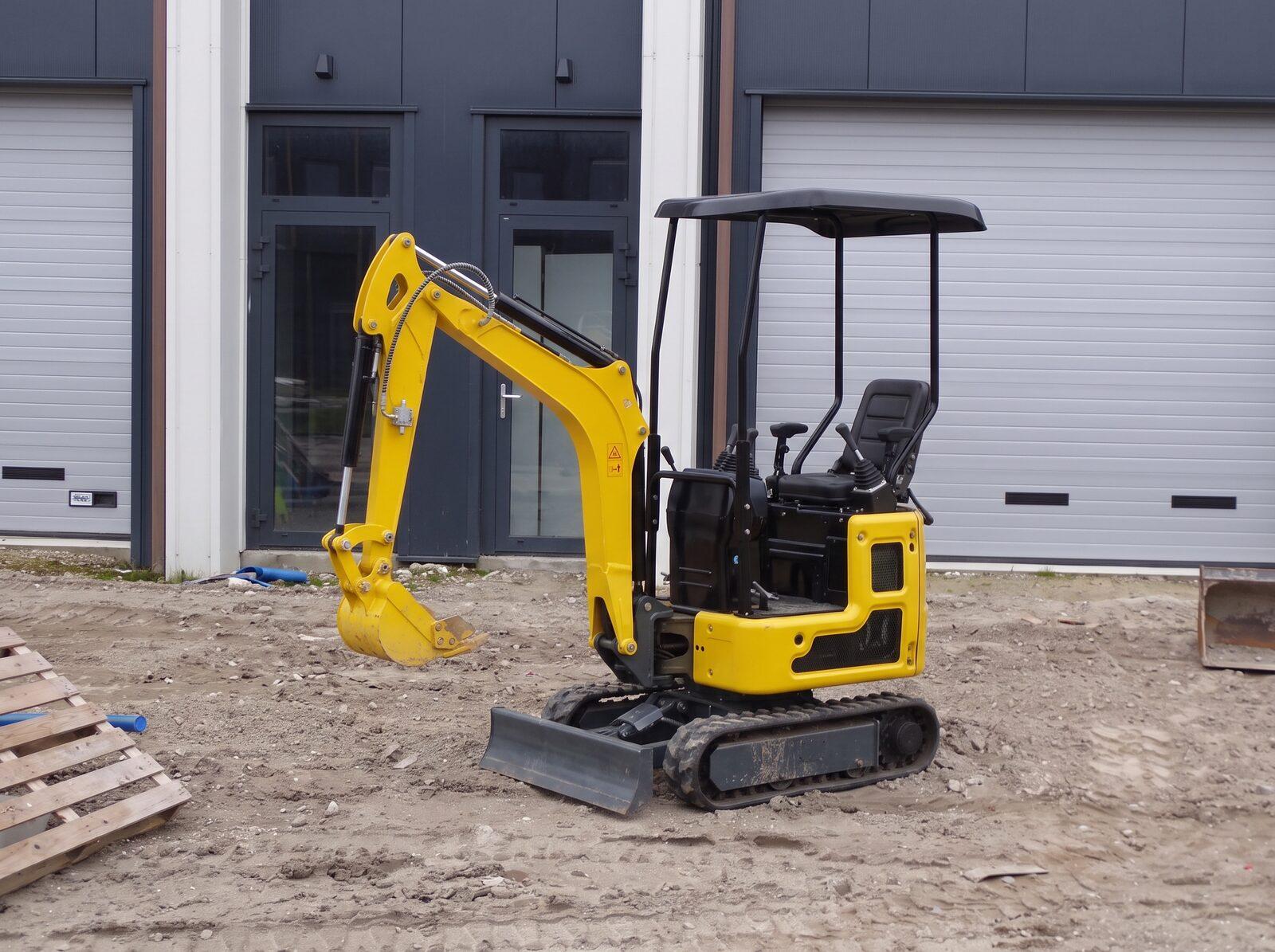
Most people choosing a first mini excavator are deciding between a 1-tonne and a 1.7-tonne machine. On paper the difference looks small. In practice it decides whether the machine fits through your side gate, what you need to tow it, how deep you can dig, and how long a job takes. Here are the real numbers from manufacturers' specification sheets, and how to match them to your property.
The size classes side by side
| Under 1 t (micro) | 1 t | 1.5 to 1.8 t | 2.5 to 3.5 t | |
|---|---|---|---|---|
| Operating weight | under 1 tonne | about 950 – 1,200 kg | about 1,700 – 1,850 kg | 2,500 – 3,500 kg |
| Narrowest width | narrower still | about 680 – 900 mm | about 955 – 1,000 mm | wider; too wide for most side gates |
| Digging depth | shallower | about 1.5 – 1.8 m | about 2.2 – 2.3 m | deeper still |
| Towing | light trailer | trailer usually under 2,000 kg loaded | trailer usually over 2,000 kg loaded | heavy plant trailer or a truck |
| Typical jobs | indoor demolition, very tight access | backyards, irrigation and power trenches, posts, stumps | septic and drainage trenches, bulk digging, bigger stumps | footings, driveways, bulk earthworks |
Ranges from the reference machines in the next section, rounded. Specs vary by model, arm length and canopy.
1 tonne vs 1.5 tonne vs 1.7 tonne: real specs compared
We pulled the figures for seven well-known machines from manufacturers' own pages and brochures. Our own machine's published figures follow the table.
Weight, narrowest width and digging depth
| Machine | Class | Weight (kg) | Narrowest width (mm) | Dig depth (mm) | Reach (mm) | Engine (kW) |
|---|---|---|---|---|---|---|
| Kubota K008-5 | 1 t | about 975 | 700 | 1,720 | 3,020 | 7.6 |
| Yanmar SV08-1 | 1 t | 1,035 | 680 | about 1,500* | about 2,730* | 7.7 |
| Kubota U10-5 | 1 t | 1,050 | 750 | 1,800 | 3,330 | 7.6 |
| Cat 301.5 | "1.5 t" | 1,775 | – | 2,340 | 3,800 | 15.7 |
| Takeuchi TB216 | 1.7 t | 1,770 | 980 | 2,190 | 3,900 | – |
| Kubota U17-5 | 1.7 t | 1,785 | 1,000 | 2,290 | 3,880 | 11.8 |
| Yanmar ViO17 | 1.7 t | 1,830 | 955 | 2,160 | – | 10.1 |
Sources, checked 13 November 2026: Kubota Europe (K008-5, U10-5), Yanmar Australia (SV08-1), Cat (301.5), Takeuchi brochure from its Australian distributor (TB216), Kubota Australia and Europe (U17-5), Yanmar UK (ViO17). Kubota's European and US pages differ on some K008-5 and U10-5 figures; we've used the European operating weights. *Yanmar SV08-1 depth and reach from a third-party spec database, not Yanmar.
Two things stand out:
- Weight jumps, not creeps. There's little between 1 and 1.2 tonnes, then the next common class sits at about 1.8 tonnes. The Cat 301.5, sold as a 1.5-tonne, weighs 1,775 kg.
- Width varies a lot within the 1-tonne class. Japanese 1-tonne machines pull their tracks in to 680 to 750 mm. Some Chinese-built 1-tonne machines, including our PD12, are around 900 mm. The 1.7-tonne machines are 955 to 1,000 mm.
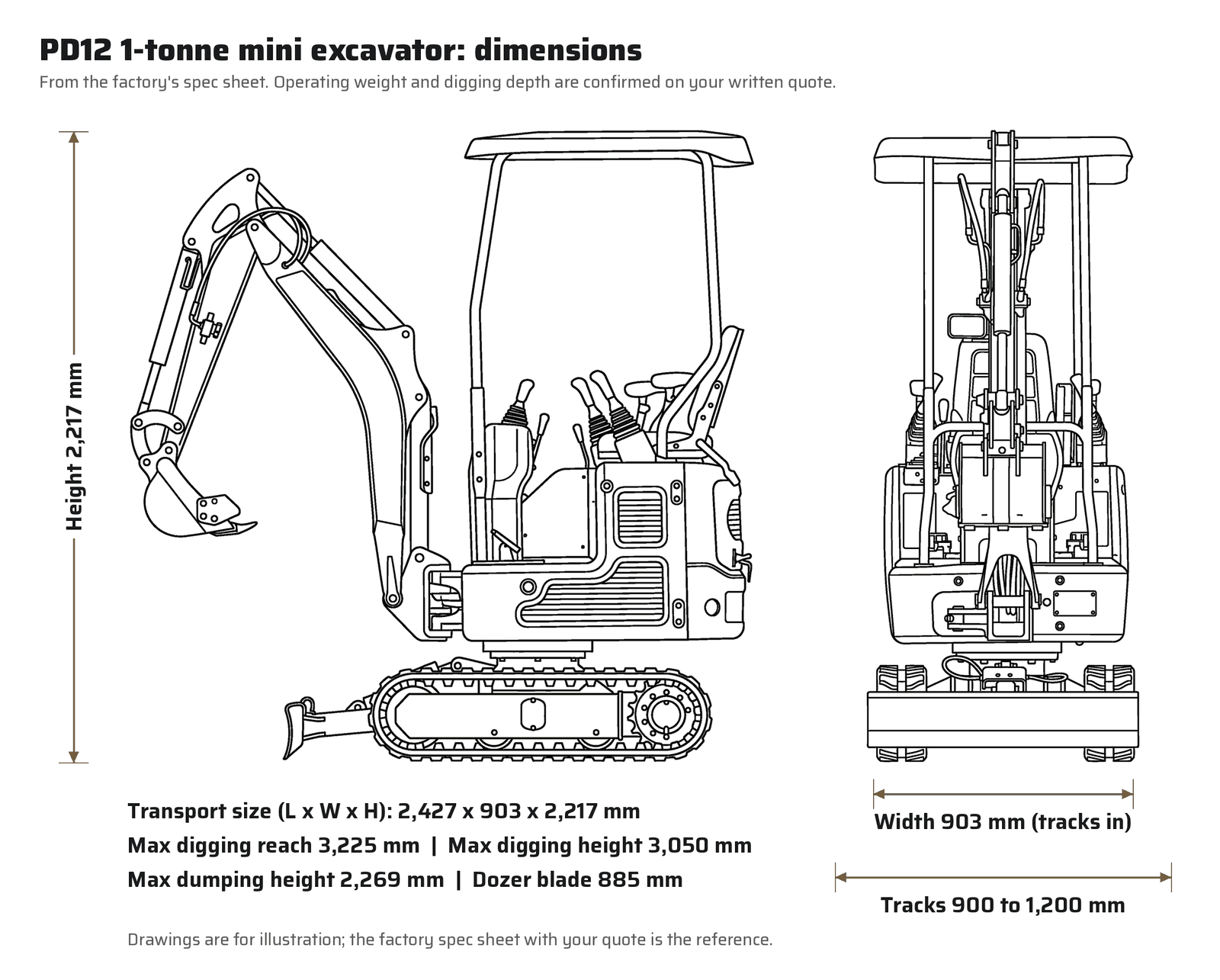
Our PD12's published figures: 903 mm wide with the tracks in and 1,200 mm with them out, 2,427 mm long and 2,217 mm high for transport, 3,225 mm maximum digging reach, 3,050 mm digging height and a 2,269 mm dumping height. We'll add the operating weight and digging depth here once the factory confirms the final figures; until then we put them in writing on your quote. Ask us for the PD10's measurements.
What each size is good for
1 tonne
The 1-tonne class is built for small places and small jobs: trenches for irrigation, power or ag pipe, post holes with an auger, garden beds, small stumps, levelling, and digging beside fences and walls with a swing boom. It will dig a septic or stormwater trench to about 1.5 to 1.8 metres, but slowly. It's light enough to tow behind a typical ute and leaves fewer marks on lawns.
1.5 to 1.8 tonnes
This is the class most hire fleets are built around. The extra weight and reach mean bigger buckets, deeper trenches (about 2.2 to 2.3 metres), and noticeably faster bulk digging and stump removal. The cost is width (about a metre), a heavier trailer and a higher price. For one-off jobs it's often what you'll hire; see our hire or buy guide.
2.5 tonnes and up
For house footings, driveways, dams and serious earthworks. These need a heavy plant trailer or a truck, and are well beyond what most block owners need to own.
Gates and tight access
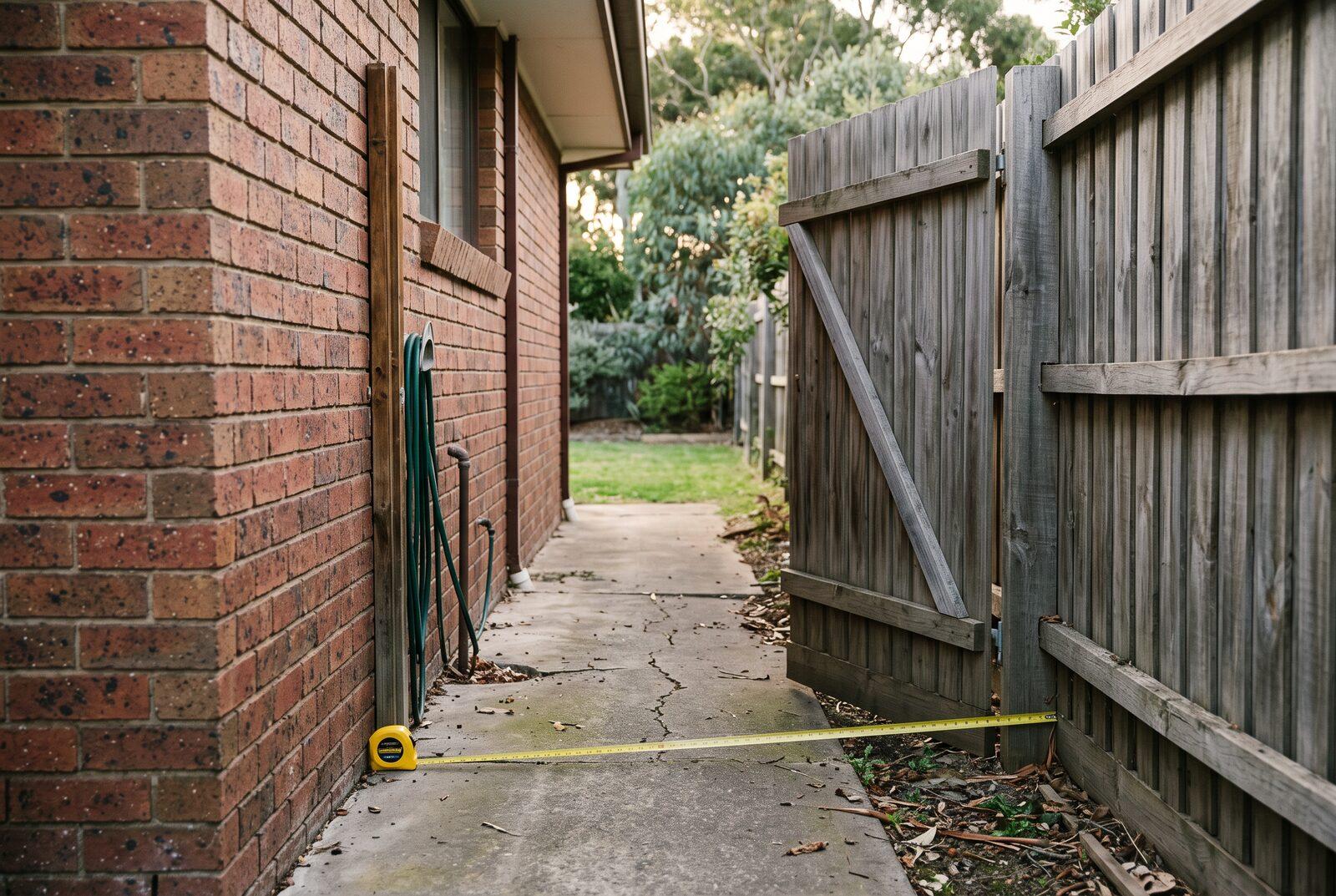
Before choosing a machine, walk the path it will take and measure:
- The narrowest gap: gate posts, side passages, between a house and a fence.
- Anything at the height of the tracks or the canopy: eaves, branches, a carport.
- Soft ground, steps or kerbs it has to cross, and whether lawn or paving needs protecting.
Compare the narrowest gap with the machine's width with its tracks pulled in, and leave some margin for steering. One Brisbane hire company describes 820 mm as a standard side gate, which only the narrowest 1-tonne machines fit through. Our PD12 needs a gap of a little over 900 mm, so it won't fit through an 820 mm gate. If your gap is under a metre, send us the measurement before you order and we'll tell you whether our machines will fit.
Towing a mini excavator
Most owners move their machine on a plant trailer, and this is where 1 tonne and 1.7 tonnes really part ways. Under Vehicle Standards Bulletin 1, the national rules for light trailers, brakes depend on the trailer's gross trailer mass (GTM), the weight carried on its axles:
| Gross trailer mass | Brakes required |
|---|---|
| Up to 750 kg | None required |
| 750 kg to 2,000 kg | Brakes required; over-run brakes allowed; brakes may be on one axle |
| Over 2,000 kg | Brakes on all wheels, plus an emergency breakaway system |
Vehicle Standards Bulletin 1, revision 6, Department of Infrastructure (2026). GTM is the load on the trailer's axles; the trailer's ATM, which includes the weight on the towbar, is a little higher.
Machine plus trailer, against the brake rules
What that means in practice:
- Your licence. A standard car licence covers vehicles up to 4.5 tonnes GVM, and licence classes are the same in every state. How much you can tow is set by your vehicle's towing capacity and gross combination mass, and by the trailer's own rating. In NSW, P1 drivers can only tow trailers up to 250 kg unladen and learners can't tow at all.
- Your vehicle. Toyota rates a HiLux diesel 4x4 to tow 3,500 kg braked (2,900 kg for a 4x2), with a 6,300 kg gross combination mass on the 4x4. A 1-tonne machine on a trailer is well within that; a 1.7-tonne is too, but check the combination with your load and passengers.
- The trailer. Buy one rated above your loaded weight. Over 2,000 kg you'll need electric brakes on all wheels and breakaway protection, which makes trailers for 1.7-tonne machines heavier and dearer.
- Loading. Driving up the ramps is one of the riskier moments. Do it on flat, firm ground, lined up straight, slowly, with someone watching, and tie the machine down at four points with rated chains or straps.
How to choose
| If this sounds like you | Look at |
|---|---|
| Backyard or suburban block, side-gate access, jobs a few times a year | 1 tonne, checked against your gate width |
| Acreage or hobby farm: fences, trenches, stumps, drainage, tidy-ups | 1 tonne if you'll tow it or work in tight spots; 1.7 tonnes if you have room and lots of digging |
| Septic, deep stormwater or lots of bulk digging | 1.7 tonnes or bigger, or hire one for that job |
| You want to tow it behind the family ute without a heavy trailer | 1 tonne |
| Paid work for others, day after day | 1.7 tonnes and up, plus the training and insurance that go with it |
Our two machines are both 1-tonne class: the PD12 Kubota and the PD10. If you're unsure, tell us about the job and your access and we'll say whether a 1-tonne machine is the right size, including when it isn't.
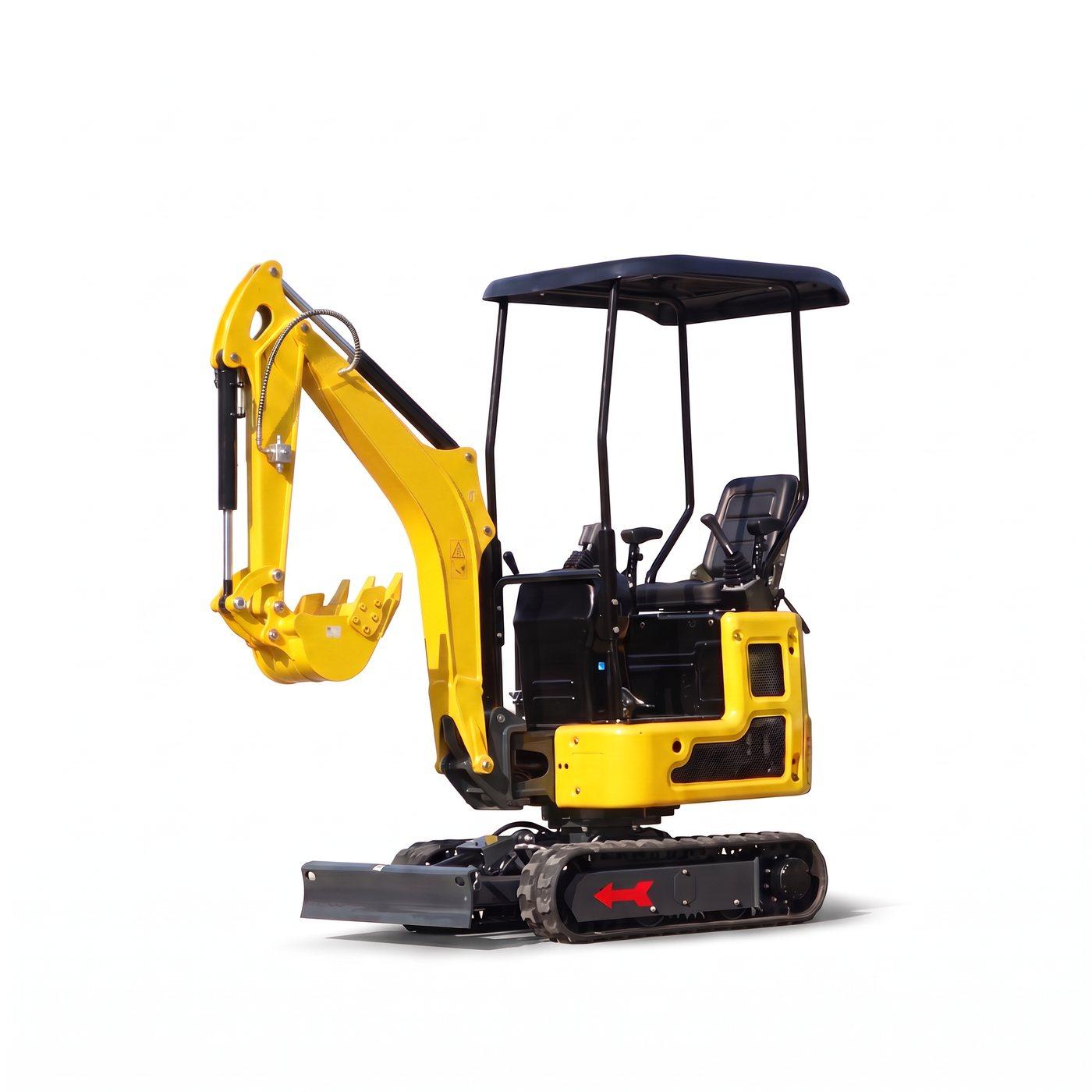 PD12 KubotaFrom A$16,490 incl GST, deliveredSee the PD12 →
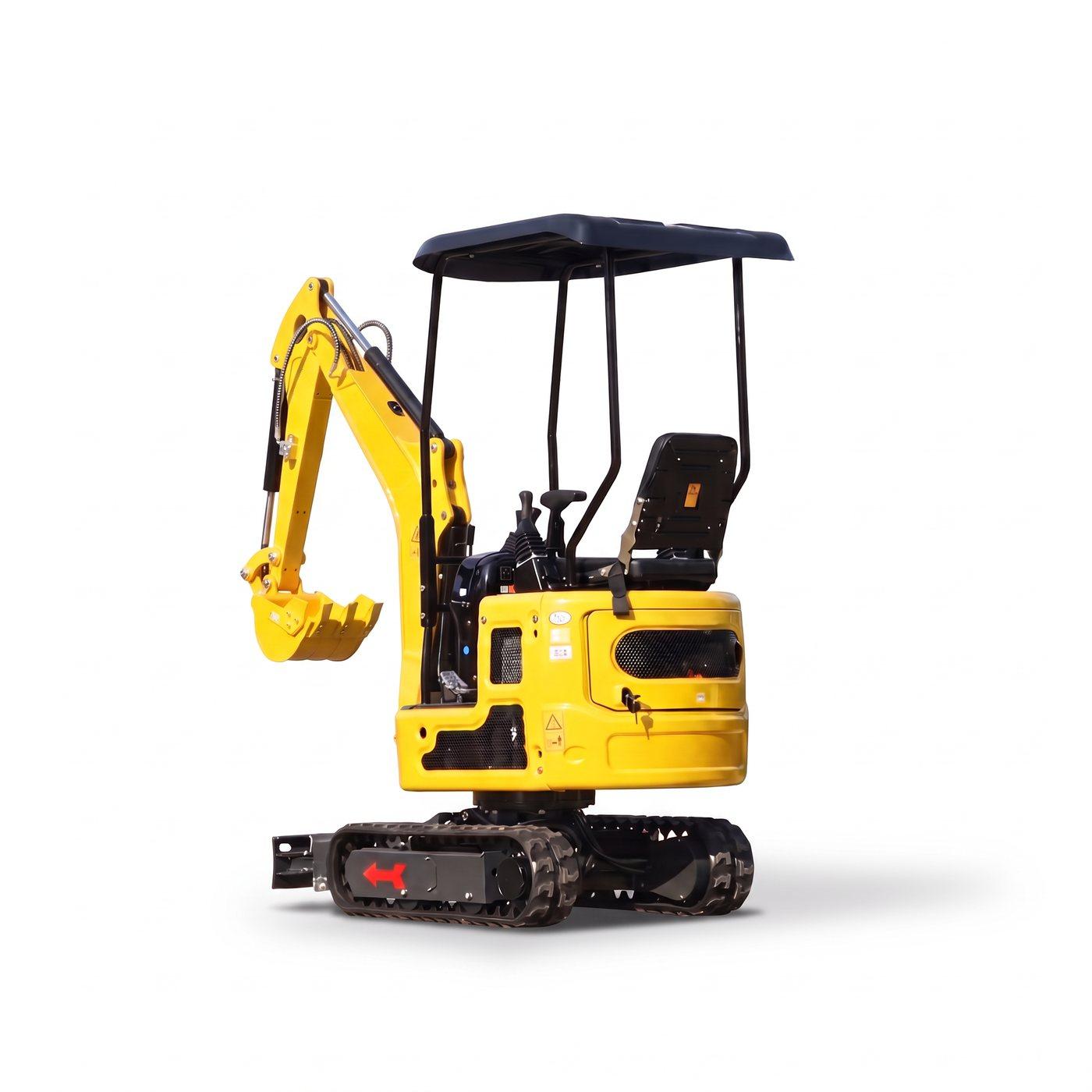 PD10 KoopFrom A$11,990 incl GST, deliveredSee the PD10 →
Common questions
How much does a 1-tonne excavator weigh?
About 950 to 1,200 kg, depending on the model and canopy. Kubota lists the K008-5 at about 975 kg and the U10-5 at 1,050 kg; Yanmar Australia lists the SV08-1 at 1,035 kg.
How big is a 1-tonne mini excavator?
Roughly 2.4 to 3 metres long, 2.2 to 2.3 metres high with a canopy, and 680 to 900 mm wide with the tracks pulled in. Our PD12 is 2,427 × 903 × 2,217 mm.
How much work can a 1-tonne mini excavator do?
Plenty of trenches, holes, garden and landscaping work, and small stumps, at a slower pace than a 1.7-tonne. It digs to about 1.5 to 1.8 metres. For big volumes of soil, a larger machine is quicker.
How much can a 1-tonne excavator lift?
Only lift with a machine that has a rated lifting point and a lift chart from the maker; ask the seller for both. Using an excavator as a crane brings extra safety rules, which our licence guide touches on.
1.5 or 1.7 tonne: what's the difference?
Often very little. Several machines sold as 1.5 tonnes weigh close to 1.8 tonnes, like the Cat 301.5 at 1,775 kg. Compare the actual operating weight and width rather than the name.
Sources
- Kubota Europe, K008-5 and U10-5 pages; Kubota Australia, U17-5 page
- Yanmar Australia, SV08 specifications; Yanmar UK, ViO17
- Cat, 301.5 product page; Toyota Material Handling Australia, Takeuchi TB216 brochure
- Vehicle Standards Bulletin 1, revision 6
- NSW Government: licence classes; towing rules
- Toyota Australia, HiLux specification sheet (September 2026)
- Trailer empty weights: Australian plant trailer makers' listings (Sureweld, Brian James, Century)
- Ryno Hire, "What can a mini excavator do: 1t vs 1.7t" (side gate width)
Not sure it will fit?
Send us your narrowest gate or path width and the job you have in mind. We'll tell you whether our machines fit, with a delivered price.
Send your measurementsWho wrote this guide
Paddock Diggers is based in Zoucheng, part of Jining in Shandong, China, a city with dozens of mini excavator factories. We sell two 1-tonne machines to Australian buyers. Each machine is checked and filmed at the factory before it ships, then delivered to your door for one written price. You pay a 30% deposit, refunded in full until the factory starts building, and the balance only after you've seen the video of your own machine. Warranty claims and parts go through us, by email and video call, with parts sent by international courier.
We write these guides from regulators' and manufacturers' own pages, dealer listings and our own quotes, list our sources, and update a guide when prices or rules change.