The short answer
- No state or territory issues a licence to operate an excavator, whatever its size. Excavators aren't one of the high risk work licence classes.
- The "excavator ticket" is a training record: a Statement of Attainment for the unit RIIMPO320F. Courses cost about A$574 to A$995 and take one to three days.
- If you employ someone or work on someone else's site, the business has to make sure the operator is competent, and anyone doing construction work needs a White Card.
- On your own land, the rules that matter are about what's underground and overhead: use Before You Dig (a legal requirement in NSW), keep well clear of powerlines, and take trenches and slopes seriously.
- In NSW, paid residential work over A$5,000 that includes digging needs a contractor licence from NSW Fair Trading.
General information, not legal advice. Checked against regulators' pages on 13 November 2026.
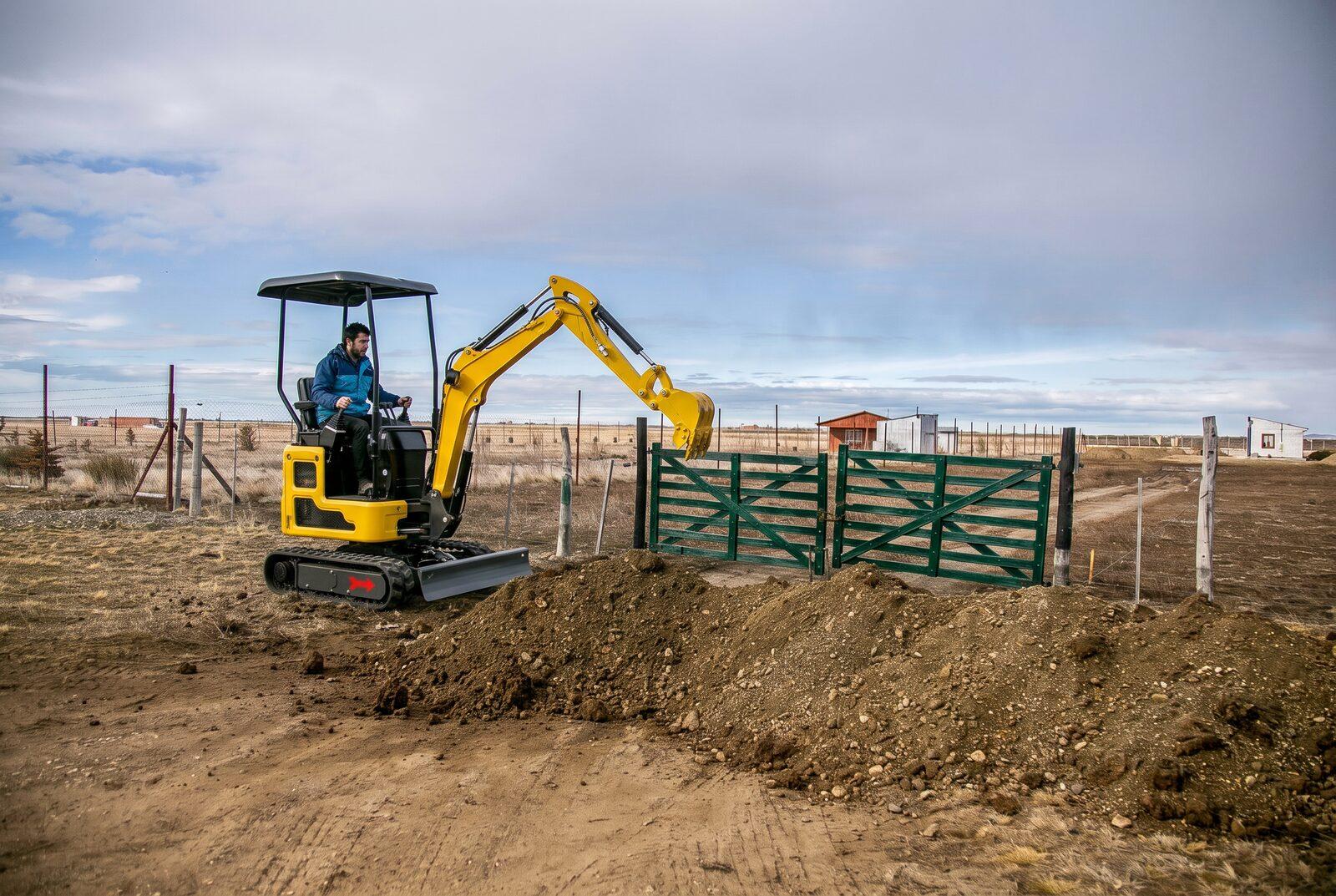
It's one of the first questions people ask before buying a mini excavator, and most of the pages that answer it are selling a course. Here's what the regulators themselves say, state by state, with links so you can check, plus the rules that actually apply when you're digging on your own place.
Is there an excavator licence in Australia?
No. The licences to operate machinery under Australian work health and safety law are the high risk work licences: cranes, forklifts, scaffolding, rigging, dogging, boilers and similar. Excavators aren't on the list, and neither are backhoes, front-end loaders, skid steers or bulldozers. The regulators say so directly:
- WorkSafe Victoria: "You don't need a high risk work licence to operate earthmoving equipment (eg excavator) or a scissor lift."
- SafeWork NSW: "High risk work licences are no longer required for earth moving plant such as excavators, front end loaders, bulldozers, leaving the onus of responsibility on the PCBU to ensure the competency of the operator." (A PCBU is a "person conducting a business or undertaking": usually the employer or the business running the job.)
- WorkSafe Tasmania: "There are no high risk work licences for someone who carries out work with front end loaders (LL), backhoes (LB), front end loaders of the skid steer types (LS) or excavators (LE)."
What size of excavator can you use without a licence? Any size. There's no weight limit, because the exemption covers excavators as a class. A 30-tonne excavator needs no more of a licence than a 1-tonne one. What changes with size is how much harm a mistake can do, and how likely a site or an employer is to insist on training.
The exception is lifting. Using an excavator as a crane brings extra rules. In Western Australia, from 10 August 2025, operating earthmoving machinery as a crane with a safe working load over 3 tonnes needs a crane licence, with some exemptions (for example, holders of a dogging licence who have done the SLELIC301 excavator lifting unit); check WorkSafe WA's current guidance if this applies to you. Lifting is meant to be done with equipment designed for it, such as an excavator with a rated lifting point and hose-burst valves. Don't use a mini excavator as a crane unless it's set up for it.
State by state
| State | Licence to operate an excavator? | What else applies |
|---|---|---|
| NSW | No | The business must ensure the operator is competent. Before You Dig is a legal requirement. Residential work over A$5,000 that includes excavating needs a NSW Fair Trading contractor licence (fines up to A$22,000 for individuals and A$110,000 for companies). |
| VIC | No | WorkSafe's "No Go Zone" for plant near overhead powerlines: up to 6.4 m from lines up to 66 kV, 10 m above that, unless you have the network operator's permission. |
| QLD | No | The old earthmoving (EPC) certificates, including LE for excavators, are no longer needed. Businesses must make sure operators are competent; WorkSafe Queensland accepts old certificates, a RIIMPO320 statement, logbooks or references, or structured in-house training as evidence. |
| WA | No, for digging | Since 10 August 2025, a crane licence (CN or C2) is needed to use earthmoving machinery as a crane with a safe working load over 3 tonnes, with some exemptions. Check WorkSafe WA for the current position. |
| SA | No | SA uses the national licence classes, which have no excavator class. |
| TAS | No | WorkSafe Tasmania says so in plain words (quoted above); the business must still train operators. |
| ACT | No | WorkSafe ACT lists 29 licence classes, none of them for excavators. |
| NT | No | The NT follows the same national licence classes; none covers excavators. |
Regulator pages checked 13 November 2026. NSW, Queensland, WA, SA, Tasmania, the ACT and the NT follow the national model WHS laws; Victoria has its own OHS laws.
What the "excavator ticket" really is
When a job ad or a site asks for an "excavator ticket", they mean a Statement of Attainment for the national training unit RIIMPO320F, Conduct civil construction excavator operations, issued by a registered training organisation (RTO). It's proof you've been trained and assessed, not a government licence, and it doesn't expire the way a licence does.
The unit covers four things:
- planning and preparing the work, including checking the site and the machine;
- operating the excavator;
- lifting, carrying and placing materials;
- selecting, fitting, using and removing attachments.
To pass, you have to show the work on at least two occasions and fit, test, use and remove at least three attachments. The unit itself says it isn't enough on its own to load and unload the machine from a trailer; that's a separate unit, or you do it with someone experienced.
Excavator course cost and how long it takes
| Provider and location | Price | Length |
|---|---|---|
| Kallibr, NSW | A$574 | 3 days |
| Construction Training Group, Melbourne | A$590 | 3 days |
| Kallibr, Victoria | A$640 | 3 days |
| Kallibr, Queensland | A$700 | 3 days |
| ATTC, Queensland | A$800 | 3 days plus pre-reading; funding available |
| RMS Training, Perth | A$890 | Online theory, then 1 practical day |
| Major Training, Brisbane | A$995 | – |
Prices from the training providers' own pages, checked November 2026. Prices change and some providers offer funding; check before you book.
Do you need one for your own block? Legally, no. It's still worth considering if you've never driven an excavator, want to work for others later, or your insurer or a hire firm asks what experience you have. Many courses ask for a White Card before the practical day.
Your own land vs someone else's site
Do you need a ticket or a White Card?
| Situation | What applies |
|---|---|
| Digging on your own property, for yourself | No licence or ticket. You're still responsible for damage to underground services and for anyone you put at risk. |
| You employ or pay someone to operate it | You're running a business or undertaking, so you must give information, training, instruction and supervision, and make sure the operator is competent. Keep a record of how you know. |
| Construction work, including on a building site | Everyone doing construction work needs general construction induction training (the White Card, CPCCWHS1001). Sites usually also ask for proof of competency, often a RIIMPO320F statement. |
| Paid digging for other people's homes in NSW | A NSW Fair Trading contractor licence once the job is worth more than A$5,000. |
| Driving it on a public road | In NSW a tracked excavator needs conditional registration, a car licence, a rotating amber beacon, reflectors, mirrors, a horn and a traffic control plan. Simply crossing a road between parcels of land used for primary production is exempt from registration. Other states run their own conditional registration schemes. |
The rules that matter on your own block
Find out what's underground first
Before You Dig Australia is a free referral service: you lodge your dig site and the owners of pipes and cables there send you plans. In NSW it's a legal requirement to use it before excavating, and SafeWork NSW's message is simple: "Don't dig blind." Elsewhere it's still the first thing to do. Plans show roughly where services run, not exactly, so dig carefully by hand near the marked lines.
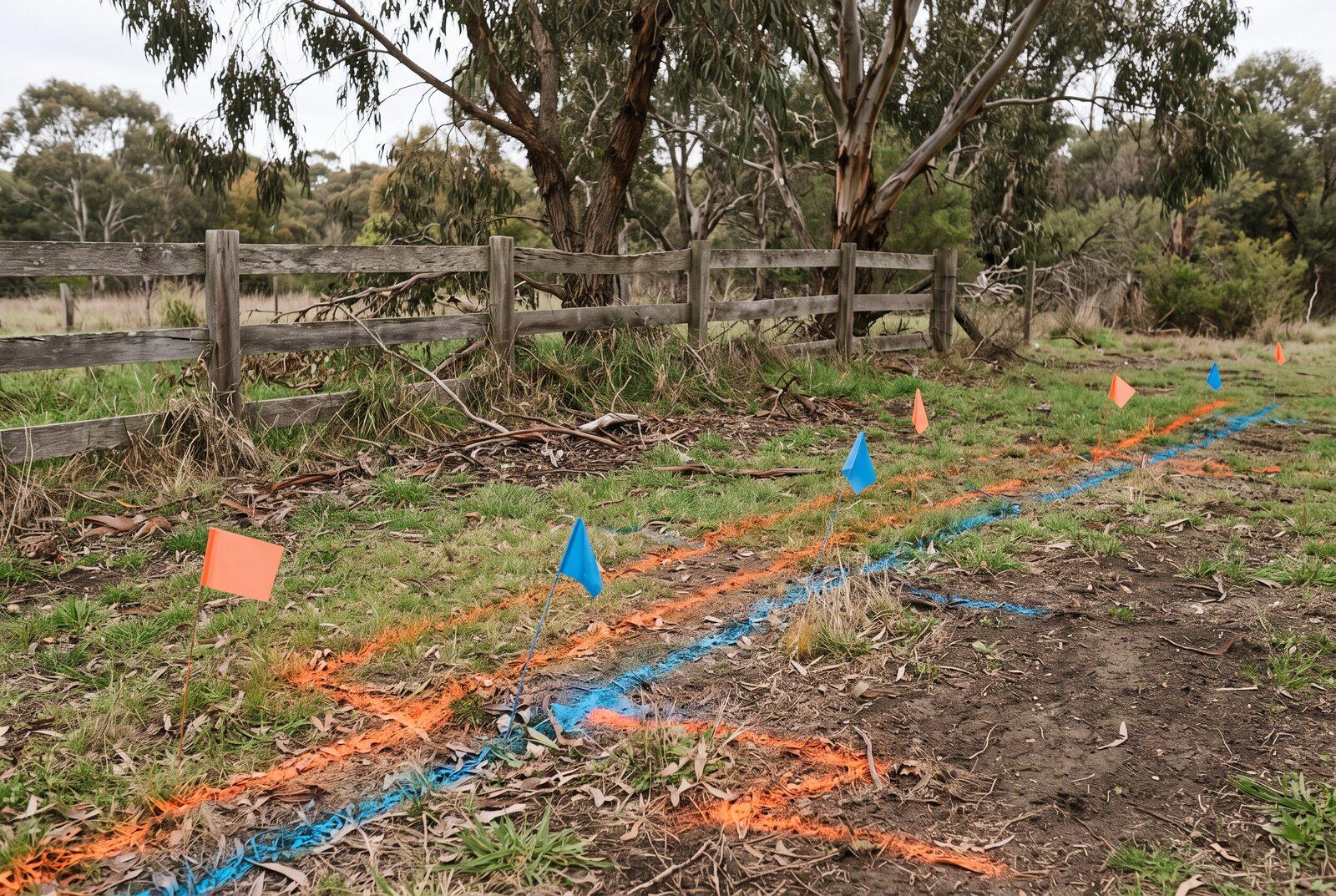
On farms, also think about your own services that won't be on anyone's plans: a poly pipe to a trough, a power cable to a pump, a septic line. Walk the area with whoever put them in if you can.
Stay well clear of powerlines
A mini excavator's arm reaches more than three metres up. WorkSafe Victoria's No Go Zone keeps plant 6.4 metres from overhead lines up to 66 kV, and 10 metres from higher-voltage lines, unless the network operator has given you permission and conditions. Other states have similar rules. If you need to work near a line, call the network operator first.
Treat trenches with respect
Trench walls can collapse without warning, and a cubic metre of soil weighs more than a tonne. On work sites, trenches 1.5 metres or deeper must be protected by shoring, battering or benching. It's a good rule at home too: don't climb into a deep trench with unsupported walls, and keep the machine and the spoil heap back from the edge.
Be careful on slopes
SafeWork NSW lists plant rollovers as the third most common type of incident in its review of earthmoving work, and 74% of the incidents it reviewed caused serious injury or death. On a slope: push the tracks out to their widest, travel straight up or down rather than across, keep the bucket low, swing slowly, and wear the seatbelt. If a slope looks too steep to walk comfortably, it's too steep to dig on. When you buy any machine, ask the seller whether the canopy is a certified rollover or tip-over protective structure (ROPS or TOPS) and fitted with a seatbelt. For our machines, we put the canopy certification and seatbelt details in writing on your quote.
Keep people out of the swing zone
The danger zone around a working excavator, seen from above
Learning to drive one
If you're not doing a course, a sensible way to start:
- Read the operator's manual, especially the daily checks and the control layout.
- Start on flat, open ground with nobody around. Practise slow, smooth movements of one lever at a time before combining them.
- Dig practice holes and fill them back in. Learn how far the machine reaches before you work near anything that matters.
- Practise tracking with the blade forward and backward, and pulling the tracks in and out.
- Only then move on to trenches, slopes or work near buildings, fences and services.
If you've hired a machine before, you'll find a 1-tonne digger has the same controls on a smaller scale. Our size guide explains what a 1-tonne machine can and can't do.
Buying for your own place? You don't need a ticket to own or drive one there. Our two 1-tonne machines are the PD12 and the PD10.
Common questions
Do I need a licence for a mini digger?
No. "Mini digger" and "mini excavator" are the same machine; digger is the everyday word. No state requires a licence to operate one.
How much is an excavator ticket in NSW?
The cheapest NSW price we found was A$574 for a three-day RIIMPO320F course in November 2026. Prices across Australia ranged from about A$574 to A$995.
Do I need a White Card to use a mini excavator at home?
The White Card is for people doing construction work. Digging on your own property for yourself doesn't call for one, but most training courses and construction sites will ask for it.
Can I drive a mini excavator on the road?
Not on its tracks without conditional registration. Most owners move theirs on a trailer. Our towing section covers trailer brakes and weights.
Will a hire company want to see a ticket?
It depends on the hirer. Some only ask about your experience; ask when you book.
This guide explains the rules in general terms and isn't legal advice. Rules change; your state's work health and safety regulator has the final say for your situation.
Sources
- Safe Work Australia: High risk work licence classes
- WorkSafe Victoria: High risk work licence (reviewed 30 June 2026)
- SafeWork NSW: Earthmoving plant in construction safety checklist
- WorkSafe Tasmania: When a high risk work licence is not required (updated 26 February 2024)
- WorkSafe WA: Earthmoving machinery used as cranes (June 2025)
- training.gov.au: RIIMPO320F Conduct civil construction excavator operations
- SafeWork NSW: White cards
- NSW Government: Excavating work licence (updated 23 June 2026)
- WorkSafe Victoria: Using powered mobile plant near overhead assets (August 2024)
- SafeWork NSW: Excavations and earthmoving plant in construction
- Transport for NSW: Conditional registration, tracked excavator (July 2025)
Thinking of buying one for your own place?
Tell us about the job and your access. We'll tell you whether a 1-tonne machine suits it, and give you a written price delivered to your door.
Ask us about your jobWho wrote this guide
Paddock Diggers is based in Zoucheng, part of Jining in Shandong, China, a city with dozens of mini excavator factories. We sell two 1-tonne machines to Australian buyers. Each machine is checked and filmed at the factory before it ships, then delivered to your door for one written price. You pay a 30% deposit, refunded in full until the factory starts building, and the balance only after you've seen the video of your own machine. Warranty claims and parts go through us, by email and video call, with parts sent by international courier.
We write these guides from regulators' and manufacturers' own pages, dealer listings and our own quotes, list our sources, and update a guide when prices or rules change.